

Introduction: A Cosmic Enigma Arrives in Milliseconds
In a universe filled with spectacular phenomena—supernovae that outshine galaxies, black holes that bend spacetime, quasars blazing from across the cosmos—there exists a class of events so brief, so sudden, and so powerful that they defy easy explanation. Fast Radio Bursts, or FRBs, are among the most perplexing discoveries in modern astronomy. First detected in 2007, these ultra-bright flashes of radio waves last mere milliseconds, yet they release more energy than the Sun does in days or even years. Their origins remain one of astrophysics’ most compelling puzzles, inspiring theories that range from exotic stellar remnants to colliding cosmic structures—and yes, even speculative whispers about advanced extraterrestrial technologies.
Despite being fleeting, FRBs carry with them stories of distant galaxies, extreme environments, and perhaps new physics waiting to be uncovered. Understanding these bursts may not only solve a modern mystery but also help us map the invisible matter scattered across the universe.Much like graphic veteran t-shirts condense powerful stories, identity, and meaning into a brief visual statement, fast radio bursts compress immense energy and information into moments so short that they challenge our ability to fully interpret their origins.
A Chance Discovery That Changed Astronomy
The story of FRBs begins with a serendipitous detection. In 2007, while reanalyzing archival data from the Parkes Radio Telescope in Australia, astrophysicist Duncan Lorimer and his student David Narkevic stumbled upon a peculiar signal. It was bright, unusually dispersed, and lasted just a fraction of a second. The burst had traveled through so much ionized material that it had to originate from well beyond the Milky Way.
At first, the scientific community was skeptical. Radio telescopes often pick up interference—microwave ovens, satellites, even malfunctioning electronics. But as more telescopes reported similar bursts, doubts faded. Multiple detections with consistent dispersion properties indicated that these signals were not terrestrial glitches but genuine cosmic phenomena. The universe, it seemed, was peppered with these mysterious flashes.
What Exactly Is a Fast Radio Burst?
FRBs are incredibly brief pulses of radio waves, lasting from less than one millisecond to a few milliseconds. Despite their brevity, they are astonishingly luminous. A single FRB can emit as much energy in radio frequencies as 500 million Suns during the short instant it appears.
Key characteristics define these bursts. First, they are highly dispersed: radio waves of different frequencies arrive at Earth at slightly different times. This dispersion is crucial because it tells scientists how much matter the signal has passed through, offering a rough estimate of its distance. Second, FRBs seem to come from all directions, suggesting that they are cosmological in origin and not confined to a particular region of the sky. Third, while most FRBs are “one-off” events that never repeat, a fascinating subset does repeat—sometimes sporadically, sometimes with surprising regularity.
This diversity has complicated efforts to determine a universal explanation. One-time bursts may require catastrophic events; repeating bursts imply something persistent and ongoing. Thus, FRBs may not have just one origin. They may represent a family of cosmic triggers, each producing similar signals with different mechanisms.
The Power of Repeating Bursts
For years after the first detection, FRBs appeared to be singular events. That changed in 2012 when the Arecibo Observatory detected the first repeating FRB, later designated FRB 121102. This discovery was groundbreaking. If some FRBs repeat, they cannot be caused by cataclysmic events like supernovae or neutron star mergers—phenomena that destroy their source.
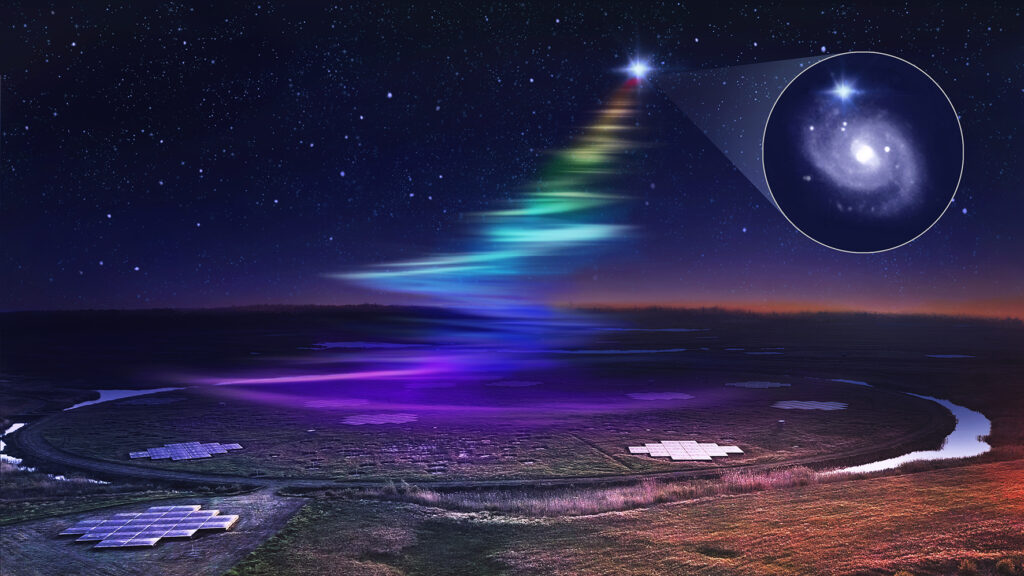
FRB 121102 continued to astonish researchers. It produced hundreds of bursts, allowing scientists to pinpoint its location: a dwarf galaxy more than three billion light-years away. Not only was its host unexpected—dwarf galaxies are not typically associated with extreme astrophysical processes—but the burst’s environment appeared unusually energetic, possibly brimming with magnetic fields and remnants of young, massive stars.
The existence of repeating FRBs opened the door to new theories involving rapidly spinning neutron stars, magnetars, or other exotic compact objects. Other repeaters have since been found, including one that appears to cycle every 16 days, hinting at orbital or rotational influences. These repetitive rhythms suggest that FRBs may be driven by stable systems, not cosmic accidents.
Magnetars: The Leading Contenders
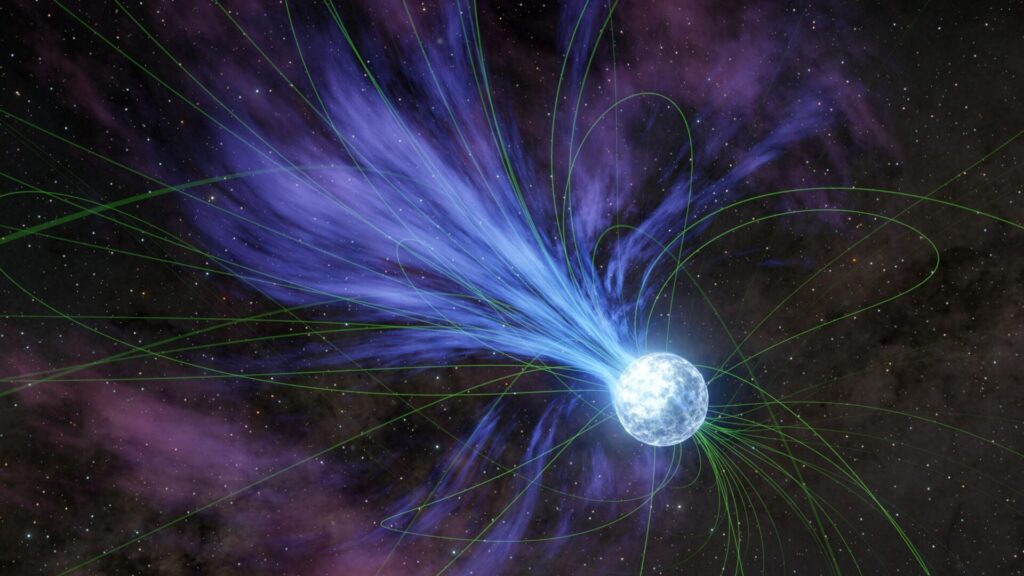
While early theories ranged widely—from black hole accretion shocks to cosmic string interactions—one explanation has gained particular traction: magnetars. These are neutron stars with magnetic fields trillions of times stronger than Earth’s, making them some of the most extreme objects in the universe. A magnetar’s magnetic field can twist, snap, and realign, unleashing bursts of energy.
In 2020, the astronomical community experienced a breakthrough. For the first time, an FRB was detected within the Milky Way. The source? A known magnetar, SGR 1935+2154, which emitted a burst significantly weaker than extragalactic FRBs but remarkably similar in pattern. This finding linked at least some FRBs directly to magnetars.
Magnetars fit many of the clues. Their environments are highly magnetized and energetic. They can produce rapid bursts, sometimes repeatedly. And their formation—often through the collapse of massive stars—could explain why FRBs are frequently found in galaxies rich in star formation.
Still, magnetars cannot account for everything. Some FRBs have properties difficult to reconcile with known magnetar physics, such as extreme brightness or unusual frequency structures. This suggests that while magnetars might explain a substantial portion of FRBs, they are unlikely to be the only source.
Exotic Theories and the Allure of the Unexplained
Astrophysics thrives on bold ideas, and FRBs have inspired many. Some researchers propose that FRBs might be produced when neutron stars collide with black holes or when white dwarfs collapse into neutron stars. Others imagine relativistic shocks in gamma-ray burst jets or interactions between stars and dark matter clouds.
The most speculative theories enter the realm of the extraordinary. One suggestion, rooted loosely in the search for extraterrestrial intelligence, posits that FRBs might be leakage from advanced civilizations using powerful energy beams for propulsion—perhaps to drive light sails across interstellar distances. While mainstream scientists consider this unlikely, FRBs’ extreme properties do not entirely rule out technological possibilities.
Yet, extraordinary claims require extraordinary evidence. To date, all FRB observations can be explained using natural astrophysics, even if the details remain elusive. But the mystery persists, fueling both rigorous inquiry and imaginative thinking.
What FRBs Reveal About the Universe
Even before their origins are fully understood, FRBs have become valuable tools for studying the cosmos. Their dispersion measures help researchers estimate the amount of ionized gas between galaxies, offering a way to “weigh” the otherwise invisible matter that permeates space. This has provided crucial evidence for the distribution of baryonic matter—the regular matter composed of protons and neutrons—that was previously difficult to detect.
FRBs may also be used to map magnetic fields across vast cosmic distances. The polarization of their radio waves can reveal how magnetic structures shape intergalactic space. Over time, an entire “FRB cosmology” may emerge, using these brief flashes as probes of the universe’s large-scale structure.
The Technology Behind the Discoveries
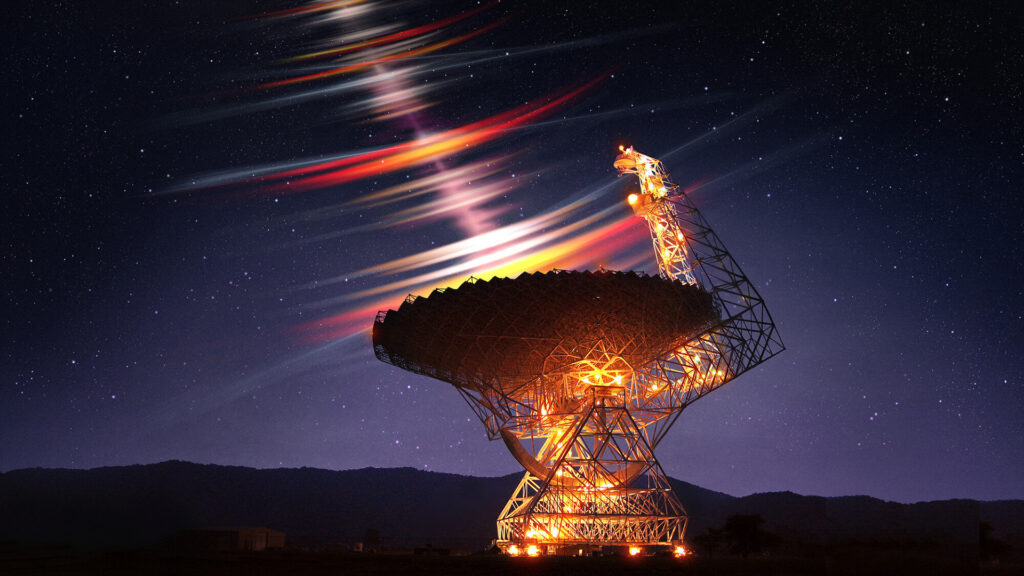
The rise of FRB research owes much to advancements in radio astronomy. Modern telescopes like CHIME in Canada, ASKAP in Australia, and MeerKAT in South Africa use wide-field designs and sophisticated software to scan the sky continuously. Unlike older telescopes that viewed narrow slices of the sky, these arrays can detect dozens or even hundreds of FRBs per year.
CHIME has been especially transformative. Since coming online, it has identified more FRBs than all previous observatories combined. Its success lies in its ability to monitor vast portions of the sky every day, capturing both new bursts and repeat offenders. This deluge of data allows scientists to identify patterns, classify bursts, and test theoretical models more rigorously than ever before.
A Mystery That Continues to Evolve
Although the field has made tremendous strides, the mystery of Fast Radio Bursts is far from solved. Each new detection adds another piece to a puzzle that is both thrilling and confounding. Some FRBs fit neatly into existing theories; others challenge them outright. Some repeat; others never return. Some exhibit peculiar structures that suggest complex processes at work.
The beauty of FRBs lies in this ambiguity. They represent a frontier where theory and observation meet in real time, where scientists grapple with data that arrives in bursts lasting less than the blink of an eye. In many ways, the study of FRBs embodies the spirit of modern astrophysics: dynamic, global, collaborative, and eager to tackle mysteries without easy answers.
Conclusion: Messages From the Cosmic Unknown
Fast Radio Bursts remind us that the universe remains full of surprises, even in an era when humanity can peer across billions of light-years. These millisecond flashes challenge our assumptions about what celestial objects can do and how energy can be released. They reveal the power of extreme physics, the complexity of galactic environments, and the potential for entirely new kinds of cosmic engines.
As telescopes grow more sensitive and theories more refined, the nature of FRBs will gradually come into focus. Whether they originate from magnetars, exotic stellar interactions, or phenomena we have yet to imagine, they offer a glimpse into some of the most energetic processes in the universe. And in their fleeting brilliance, they remind us that even the briefest signals can illuminate profound truths about the cosmos.
About the Author
