

In the vast darkness of the cosmos, some objects shine with a fury so intense that they outshine entire galaxies. Quasars and blazars are among the most luminous and energetic phenomena ever discovered, acting as cosmic lighthouses that can be seen from billions of light-years away. These extraordinary objects offer astronomers a window into the early universe, the behavior of supermassive black holes, and the extreme physics that govern matter and energy under conditions impossible to replicate on Earth.
Though they appear as tiny points of light through telescopes, quasars and blazars are anything but small. They are powered by black holes billions of times more massive than the Sun, consuming surrounding matter in a process so violent and efficient that it releases unimaginable amounts of radiation.
The Birth of a Cosmic Mystery
The story of quasars began in the early 1960s when astronomers noticed peculiar radio sources in the sky. These objects looked star-like in visible light but emitted powerful radio signals. When their light was analyzed, it revealed enormous redshifts, meaning they were at staggering distances from Earth and therefore incredibly luminous. The term “quasar” comes from “quasi-stellar radio source,” reflecting their star-like appearance and strong radio emission.
Blazars were identified later as a strange and highly variable subset of active galactic nuclei. They showed dramatic fluctuations in brightness and polarization over very short periods of time, something that puzzled scientists for years.
The Power Source: Supermassive Black Holes
At the heart of every quasar and blazar lies a supermassive black hole. These gravitational monsters sit at the centers of galaxies and can have masses ranging from millions to tens of billions of times that of the Sun. However, the intense brightness of quasars and blazars does not come from the black hole itself, since black holes do not emit light. Instead, it comes from the material that falls toward them.
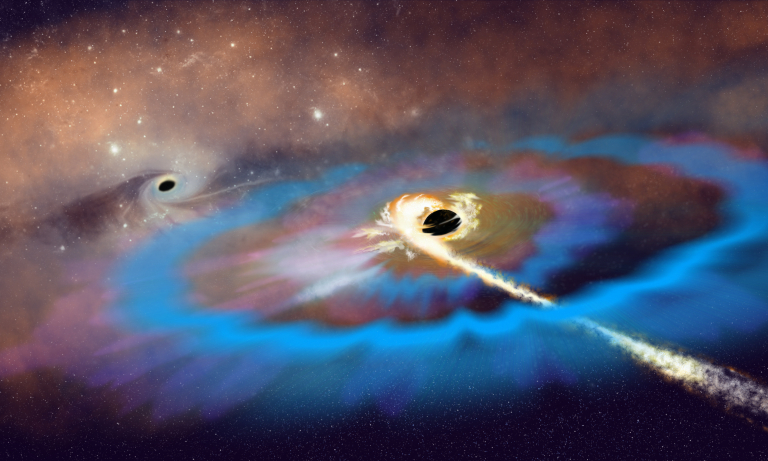
As gas, dust, and stars are drawn in by the black hole’s gravity, they form a swirling structure known as an accretion disk. Friction and gravitational forces within this disk heat the material to extreme temperatures, causing it to glow across the electromagnetic spectrum. When conditions are right, magnetic fields near the black hole channel part of this infalling matter into narrow, high-speed jets that shoot out from the galaxy’s core at velocities close to the speed of light.
What Makes a Quasar
A quasar is essentially an extremely luminous active galactic nucleus. From Earth, it appears as a bright, star-like point, but in reality it is the blazing heart of a distant galaxy. Quasars can emit more energy than hundreds of billions of stars combined. Some of them are visible across nearly the entire observable universe, making them valuable tools for studying the distant past.
The light of quasars often shows distinctive spectral lines, which provide clues about the elements present and the speed at which the quasar is moving away from us due to cosmic expansion. Because their light has traveled for billions of years to reach Earth, observing quasars allows astronomers to look back in time.
The Unique Nature of Blazars
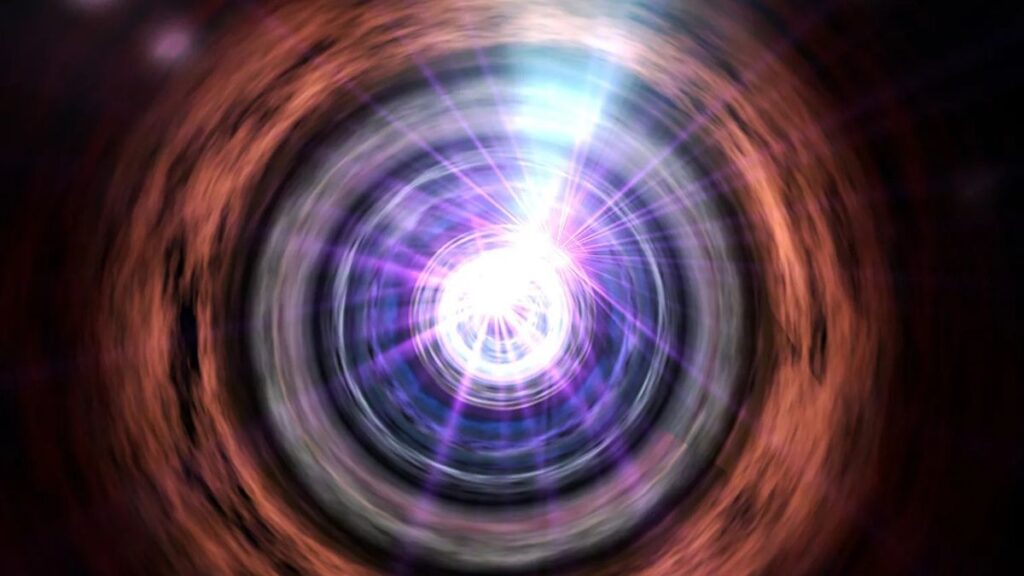
Blazars are a special and particularly extreme type of quasar or active galactic nucleus. The defining feature of a blazar is its orientation. In a blazar, one of the relativistic jets produced by the black hole is pointed almost directly toward Earth. This alignment creates a phenomenon known as relativistic beaming, where the emitted radiation is highly concentrated in our direction, dramatically boosting the observed brightness.
Because of this alignment, blazars are among the most violent and unpredictable objects in the sky. They can change brightness in a matter of hours or even minutes, producing sudden flares across radio, optical, X-ray, and gamma-ray wavelengths. These fluctuations reveal valuable information about the size and structure of the regions near the black hole, as well as the behavior of particles moving at near-light speeds.
Light Across the Spectrum
One of the remarkable features of quasars and blazars is the breadth of the light they emit. Unlike ordinary stars, which mostly shine in visible light, these objects radiate across the entire electromagnetic spectrum. They produce radio waves, infrared heat, visible light, ultraviolet radiation, X-rays, and gamma rays.
This multiwavelength emission allows astronomers to use a wide array of telescopes to study them. Radio telescopes trace the structure of their jets across intergalactic space. Optical and ultraviolet instruments probe the glowing accretion disk. X-ray and gamma-ray observatories reveal the most energetic processes taking place near the black hole. By combining data from different wavelengths, scientists can build a more complete picture of how these cosmic engines function.
Cosmic Lighthouses of the Early Universe
Quasars are not just fascinating objects in their own right; they are also crucial landmarks in the cosmic landscape. Because they are so bright, they can be seen at extraordinary distances, making them excellent probes of the early universe. Astronomers use their light to study the intergalactic medium, the thin gas that fills the space between galaxies.
As quasar light travels toward Earth, it passes through clouds of gas and dust. These clouds leave telltale absorption lines in the quasar’s spectrum, allowing scientists to identify their composition, temperature, and motion. This technique has revealed how elements like hydrogen and helium evolved over cosmic time and how large-scale structures in the universe formed.
Jets That Shape Galaxies
The jets produced by quasars and blazars are not just spectacular; they are also influential. These high-speed outflows can extend for hundreds of thousands of light-years and carry enormous amounts of energy into their host galaxies and beyond. This process, known as feedback, can dramatically affect how galaxies evolve.
When a quasar is active, its jets and radiation can heat or blow away gas that would otherwise form new stars. This can slow or even halt star formation in the host galaxy. Paradoxically, under certain conditions, the jets can also compress gas in surrounding regions and trigger bursts of star formation. In this way, quasars and blazars play a complex role in shaping the life cycles of galaxies across the universe.
Extreme Physics in Action
Quasars and blazars serve as natural laboratories for extreme physics. The environments around their black holes involve gravitational fields so strong that they significantly warp spacetime, as described by Einstein’s theory of general relativity. The jets contain particles accelerated to energies far greater than anything produced in human-made particle accelerators.
Studying these objects helps physicists test their theories under the most extreme known conditions. Observations of their polarized light also provide insights into the behavior of magnetic fields in high-energy environments. In some cases, blazars have been linked to the detection of high-energy neutrinos, nearly massless particles that pass through ordinary matter with ease, opening a new era of multimessenger astronomy.
The Difference Between Quasars and Blazars
Though closely related, the main difference between quasars and blazars lies in orientation and observed behavior. A quasar is an active galactic nucleus seen from an angle where the jets are not aimed directly at Earth. As a result, its light appears steadier and less dramatically variable. A blazar, by contrast, has a jet pointed almost straight at us, causing strong variability, intense brightness, and distinct polarization properties due to relativistic effects.
This understanding has unified many previously puzzling categories of active galaxies into a coherent model based on geometry. It demonstrates how much of what we observe in the universe depends not only on the nature of an object but also on our viewing angle.
Modern Discoveries and Ongoing Mysteries
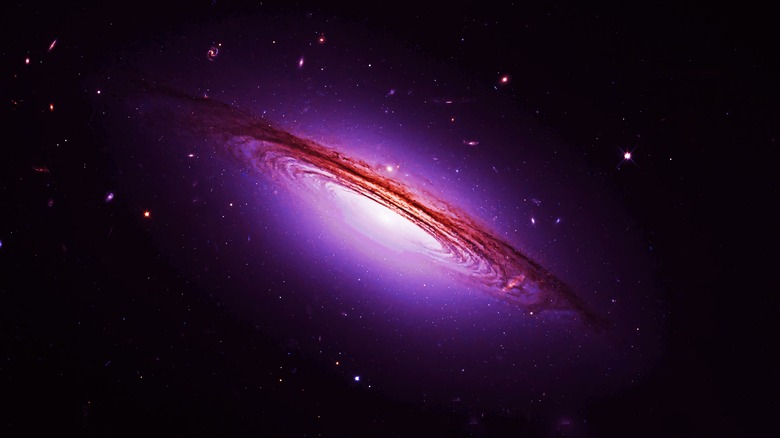
Despite decades of research, quasars and blazars continue to surprise astronomers. New telescopes and observatories are constantly revealing more about their behavior and structure. Space-based observatories like the James Webb Space Telescope are providing unprecedented views of distant quasars and their host galaxies. High-energy gamma-ray observatories are discovering new classes of blazars and exploring their connection to cosmic rays.
Yet many questions remain unanswered. It is still unclear how supermassive black holes grew so quickly in the early universe, reaching enormous masses in such a short cosmic time. The exact mechanisms that launch and stabilize relativistic jets are still the subject of intense study. Each new discovery adds complexity to the picture while bringing scientists closer to understanding these extraordinary phenomena.
Beacons in the Darkness
Quasars and blazars stand as some of the most awe-inspiring objects in the universe. They are beacons that pierce the cosmic darkness, visible across unimaginable distances and timescales. Powered by supermassive black holes and fueled by infalling matter, they reveal the raw power that lies at the hearts of galaxies.
Beyond their visual spectacle, they are essential tools for exploring the structure and history of the universe. They illuminate the distant past, shape the galaxies around them, and push the boundaries of known physics. As technology advances and our instruments become more sensitive, these brightest beacons of the cosmos will continue to guide humanity’s understanding of the universe, shining light on mysteries that stretch across space and time.
About the Author
