
A Telescope Above Earth: The Hubble Space Telescope and the Turning Point in Space Observation

A Telescope Above Earth: The Dream of Seeing Clearly Beyond the Atmosphere
For most of human history, our understanding of the universe was filtered through the restless air above our heads. Even the most powerful ground-based telescopes were at the mercy of Earth’s atmosphere, which bends, blurs, and absorbs light before it ever reaches a mirror. Stars twinkled beautifully to the naked eye, but to astronomers, that twinkling was a problem. It distorted precision, hid distant objects, and limited how deeply humanity could peer into space. The idea of placing a telescope above Earth, free from atmospheric interference, existed long before the technology to make it real. By the mid-twentieth century, as rockets began escaping gravity’s grip, that idea transformed from science fiction into a daring scientific ambition.
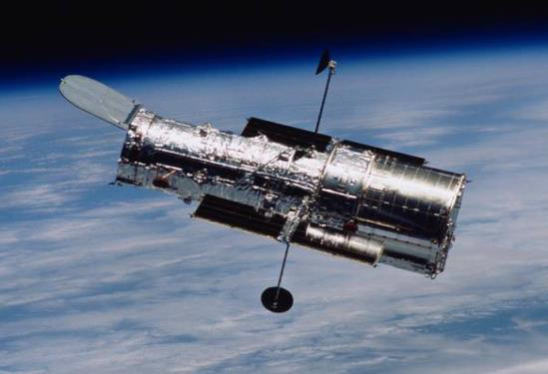
The Hubble Space Telescope emerged from this ambition as a bold promise: a permanent observatory in orbit that could observe the universe with unprecedented clarity. It was not simply another scientific instrument. Hubble represented a turning point, a moment when humanity chose to move its eyes beyond the planet and into the vacuum of space itself.
From Concept to Orbit: How Hubble Was Born
The roots of Hubble stretch back to the 1940s, when astronomer Lyman Spitzer argued passionately for a space-based telescope. He understood that escaping the atmosphere would unlock wavelengths of light that never reach the ground, such as ultraviolet radiation. For decades, the idea lingered, constrained by cost, politics, and technological limits. It was only during the space race, when spaceflight became a strategic and symbolic priority, that the vision gained real momentum.
NASA formally approved the Large Space Telescope project in the 1970s, later renamed in honor of Edwin Hubble, whose work had revealed that the universe extended far beyond the Milky Way. International cooperation played a crucial role, with the European Space Agency contributing key instruments and solar panels. From the beginning, Hubble was designed to be serviceable by astronauts, a radical choice that would later prove decisive.
When Hubble finally launched aboard the Space Shuttle Discovery in April 1990, it carried enormous expectations. Scientists, engineers, and the public alike saw it as the future of astronomy. Few imagined how close that future would come to collapsing almost immediately.
A Crisis in Orbit: When Hubble Nearly Failed
Soon after Hubble began transmitting images, disappointment spread through the scientific community. The telescope’s primary mirror had been ground to the wrong shape by a microscopic error, causing severe optical distortion. Instead of the sharp, revolutionary images promised, Hubble delivered blurry results. For a mission that had cost billions of dollars, the failure was painfully public.
Yet this crisis became one of the most important chapters in space history. Rather than abandoning the telescope, NASA committed to fixing it. Engineers devised corrective optics, essentially glasses for a telescope, to counteract the flawed mirror. In 1993, astronauts aboard the Space Shuttle Endeavour performed an extraordinarily complex servicing mission, installing new instruments and restoring Hubble’s vision.
The repair did more than save a telescope. It restored confidence in human spaceflight, demonstrated the value of serviceable spacecraft, and turned Hubble into a symbol of resilience. What followed was nothing short of a scientific renaissance.
Seeing the Universe Clearly for the First Time
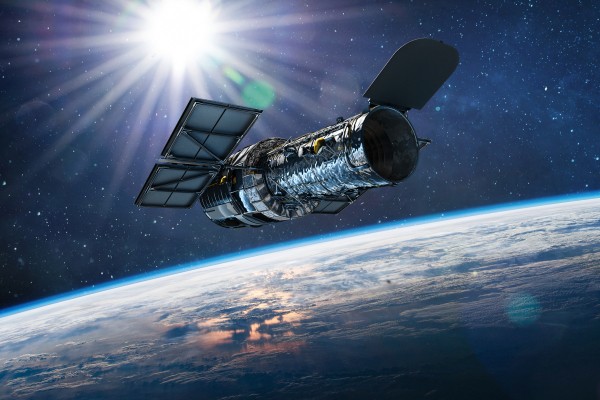
Once corrected, Hubble delivered images that stunned the world. Stars appeared as crisp points rather than smeared halos. Galaxies revealed intricate structures of dust, gas, and light. Nebulae glowed with color and complexity that ground-based telescopes had never captured.
The clarity was not just visually striking; it was scientifically transformative. Astronomers could now measure distances more accurately, observe faint objects billions of light-years away, and study cosmic phenomena across multiple wavelengths. Hubble changed observation from approximation to precision, redefining what astronomers believed was possible.
Perhaps most importantly, Hubble allowed humanity to look deep into space and, therefore, deep into time. Because light takes time to travel, observing distant galaxies meant seeing them as they existed billions of years ago. The telescope became a kind of cosmic time machine, offering glimpses of the universe in its infancy.
The Hubble Deep Field and the Expansion of Perspective
One of Hubble’s most profound contributions came from a simple yet daring decision. Astronomers aimed the telescope at a seemingly empty patch of sky and let it observe for days. The resulting image, known as the Hubble Deep Field, revealed thousands of previously unseen galaxies, each containing billions of stars.
This single image reshaped humanity’s sense of scale. What appeared empty to earlier telescopes was, in reality, overflowing with structure and history. The Deep Field showed that galaxies were not rare islands in space but abundant features of a vast and crowded universe.
Emotionally, the image carried enormous weight. It suggested that our place in the cosmos was far smaller than once imagined, yet also deeply connected to an immense cosmic story. Hubble did not just expand scientific knowledge; it expanded human perspective.
Redefining Cosmic History and the Age of the Universe
Before Hubble, estimates of the universe’s age varied wildly, with uncertainties large enough to challenge basic cosmological models. By observing Cepheid variable stars and supernovae in distant galaxies, Hubble helped refine the Hubble constant, the rate at which the universe is expanding.
These measurements led to a more accurate estimate of the universe’s age, settling long-standing debates and aligning observations with theoretical physics. Hubble also played a central role in the discovery of dark energy, the mysterious force accelerating cosmic expansion. This revelation fundamentally altered our understanding of the universe’s fate.
In this way, Hubble marked a turning point not only in observation but in interpretation. It transformed cosmology from a field filled with uncertainty into one grounded in precise, repeatable measurement.
A New Relationship Between Science and the Public
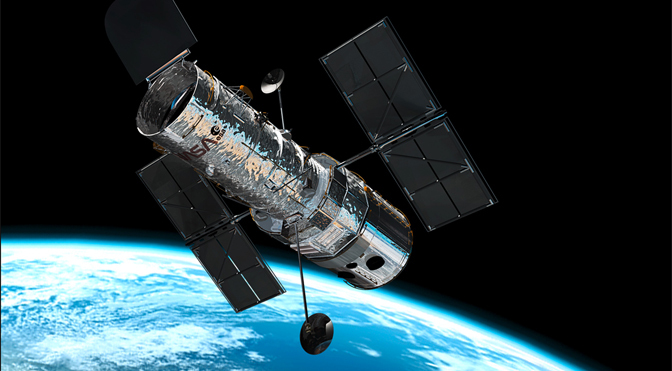
Hubble’s impact extended far beyond academic journals. Its images reached classrooms, museums, books, and living rooms around the world. For the first time, the public could see the universe not as abstract data but as vivid, breathtaking reality.
NASA made a deliberate choice to release Hubble images widely, blending scientific rigor with visual storytelling. This decision helped humanize astronomy and inspired countless students to pursue science, engineering, and mathematics. Hubble became a bridge between experts and everyday curiosity, proving that complex science could also be emotionally powerful.
The telescope’s longevity reinforced this bond. Over decades, new images arrived regularly, each one renewing public fascination and reminding audiences that exploration was ongoing, not confined to history books.
Servicing Missions and the Power of Human Intervention
Hubble’s design as a serviceable telescope proved visionary. Between 1993 and 2009, astronauts conducted multiple servicing missions, upgrading cameras, gyroscopes, and scientific instruments. Each visit effectively gave Hubble a new lease on life, keeping it technologically relevant despite rapid advances on the ground.
These missions highlighted a critical lesson in space exploration. Human presence in orbit, when combined with robotic precision, could achieve feats neither could accomplish alone. The sight of astronauts floating beside a telescope that had become a global icon was deeply symbolic. It showed humanity not just observing the universe, but actively caring for the tools that made observation possible.
The Turning Point in Space Observation
Before Hubble, astronomy was largely Earth-bound, constrained by weather, atmosphere, and geography. After Hubble, space-based observatories became essential rather than experimental. Missions such as the Chandra X-ray Observatory, the Spitzer Space Telescope, and later the James Webb Space Telescope all owe their existence to the trail Hubble blazed.
The telescope proved that placing instruments in space was not only feasible but transformative. It shifted the center of astronomical observation off the planet and into orbit, permanently changing how science approached the universe. Hubble was the moment observation left Earth behind, marking a decisive break between old limitations and new possibilities.
Hubble’s Legacy in a Changing Universe
Even as newer telescopes surpass Hubble in specific capabilities, its legacy remains unmatched. It taught scientists how to build, maintain, and operate long-term observatories in space. It reshaped cosmology, inspired generations, and embedded space exploration into global culture.
More subtly, Hubble changed how humanity thinks about progress. Its early failure and dramatic recovery offered a powerful lesson in perseverance. Its discoveries reminded us that curiosity, when paired with patience and ingenuity, can overcome even cosmic distances.
As Hubble continues orbiting Earth, silently collecting light from the farthest reaches of space, it stands as a reminder of a pivotal moment in history. A telescope above Earth did more than sharpen our vision; it changed our relationship with the universe itself.
About the Author
