

A Dream Written in the Stars
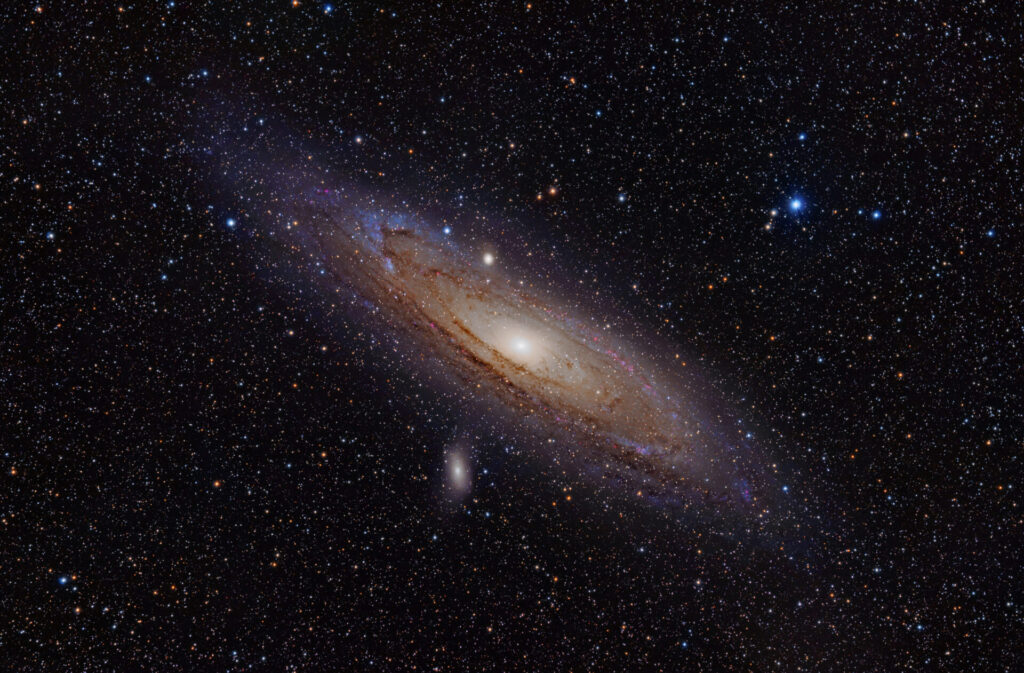
For as long as humans have looked up at the night sky, the idea of traveling beyond our world has captured the imagination. In the modern era, space travel has progressed from myth to reality, from the first satellites to robotic explorers roaming Mars. Yet even as we debate missions to nearby planets, the universe stretches far beyond anything we can currently reach. Among the countless galaxies scattered across cosmic space, Andromeda holds a special place in human curiosity. Visible to the naked eye from Earth on dark nights, it is our nearest large galactic neighbor, a majestic spiral of stars slowly drifting toward the Milky Way. The idea of traveling to Andromeda feels like the ultimate expression of exploration, but what would it truly take to make such a journey possible?
Understanding the Scale of the Journey
To grasp the challenge of traveling to Andromeda, one must first understand the sheer scale involved. Andromeda is approximately 2.5 million light-years away from Earth. A light-year is the distance light travels in one year, moving at nearly 300,000 kilometers per second. This means that the light we see from Andromeda tonight began its journey long before modern humans existed. In human terms, this distance is almost incomprehensible. Even the farthest spacecraft ever launched by humanity, Voyager 1, has traveled only a tiny fraction of a single light-year in over four decades.
Interplanetary travel already pushes our technological limits, but interstellar travel multiplies those challenges by orders of magnitude. Intergalactic travel goes further still, demanding solutions to problems we have barely begun to solve. The distance alone makes traditional concepts of spaceflight, based on chemical rockets and human lifespans, entirely insufficient.
The Limits of Current Propulsion Technology
Modern spacecraft rely primarily on chemical propulsion, a technology that has changed little since the mid-twentieth century. While powerful enough to escape Earth’s gravity and reach nearby planets, chemical rockets are woefully inefficient for long-distance space travel. Even with gravity assists and careful planning, reaching the nearest stars would take tens of thousands of years at current speeds. Andromeda, millions of light-years away, would require travel times longer than the entire history of human civilization by a staggering margin.
Alternative propulsion concepts have been proposed, including nuclear fusion engines, antimatter drives, and light sails propelled by powerful lasers. These ideas could, in theory, allow spacecraft to reach significant fractions of the speed of light. Yet even at ten percent of light speed, a journey to Andromeda would take 25 million years from the perspective of Earth. Such timescales far exceed any realistic human mission, forcing us to reconsider what we even mean by travel.
Relativity and the Nature of Time
Einstein’s theory of relativity complicates the picture in both promising and troubling ways. At velocities approaching the speed of light, time dilation becomes significant. For travelers moving at extreme speeds, time would pass more slowly compared to observers on Earth. In theory, a crew traveling at near-light speed could experience far less than 2.5 million years during the journey to Andromeda. However, reaching and sustaining such speeds presents almost insurmountable energy requirements.
The energy needed to accelerate even a modest spacecraft to near-light speed approaches the total energy output of entire stars. Additionally, decelerating at the destination would require just as much energy. Relativity offers no shortcuts that eliminate distance; it merely reshapes how time is experienced. For any civilization attempting intergalactic travel, the energy problem remains the central obstacle.
The Human Problem: Biology and Survival
Even if propulsion were solved, the human body presents another fundamental challenge. Humans evolved to live on Earth, protected by a magnetic field and atmosphere. Long-term exposure to cosmic radiation, microgravity, and isolation already poses serious risks during missions lasting months or years. A journey lasting thousands, let alone millions, of years would be biologically impossible without radical intervention.
One theoretical solution is the concept of generation ships, massive spacecraft designed to sustain multiple generations of humans. Over time, entire societies would be born, live, and die aboard a vessel slowly crossing intergalactic space. This idea raises profound social, ethical, and psychological questions. Maintaining stable populations, preventing cultural collapse, and ensuring the mission’s purpose remains intact over countless generations may be as difficult as the engineering itself.
Another possibility is suspended animation or cryogenic sleep, allowing travelers to remain dormant for most of the journey. While popular in science fiction, this technology remains speculative. No known method currently allows humans to be frozen and revived without severe damage, and maintaining such systems reliably over extreme timescales introduces further complications.
Artificial Intelligence and Post-Human Exploration
Given the immense difficulties of sending humans to Andromeda, many scientists argue that machines are the more realistic explorers. Advanced artificial intelligence could operate spacecraft, adapt to unforeseen challenges, and function for periods far exceeding human lifespans. Self-repairing probes, capable of using resources encountered along the way, could potentially survive journeys lasting millions of years.
Some futurists go even further, suggesting that humanity itself may evolve beyond its biological form. Digital consciousness, uploaded minds, or hybrid human-machine entities could endure conditions that biological humans cannot. In such scenarios, travel to Andromeda would not be a human journey in the traditional sense, but the continuation of human curiosity through transformed descendants.

Communication Across Intergalactic Distances
Traveling to Andromeda is not only about reaching the destination; it also involves maintaining contact with home. Communication across millions of light-years introduces delays so long that real-time conversation becomes impossible. A message sent from Andromeda to Earth would take 2.5 million years to arrive. By the time a response returned, entire species could have risen or vanished.
This reality forces a shift in perspective. Any mission to Andromeda would be effectively one-way in terms of meaningful interaction. The travelers would become a branch of humanity forever separated from their origin. This isolation challenges the very idea of exploration as a shared human endeavor.
Navigating the Dangers of Intergalactic Space
Intergalactic space is often imagined as empty, but it is far from harmless. Sparse clouds of gas, high-energy particles, and stray cosmic rays fill the void between galaxies. At near-light speeds, even microscopic particles can cause catastrophic damage upon impact. Shielding against such threats would add significant mass to any spacecraft, increasing energy demands even further.
Moreover, accurately navigating over millions of light-years requires extraordinary precision. Small errors in trajectory could result in missing the target galaxy entirely. Over such distances, gravitational influences from unseen matter and dark matter structures could subtly alter a spacecraft’s path, demanding constant correction and sophisticated navigation systems.
Why Andromeda Still Matters
Given these overwhelming challenges, one might ask why Andromeda continues to captivate scientific and public imagination. Part of the answer lies in its familiarity. Unlike distant, abstract galaxies, Andromeda is a visible reminder that the universe extends far beyond our cosmic neighborhood. It is also moving toward us, destined to merge with the Milky Way in several billion years, creating a new galactic structure.
Studying Andromeda from afar already teaches us invaluable lessons about galaxy formation, dark matter, and cosmic evolution. The dream of traveling there pushes scientists to think beyond incremental progress and confront the ultimate limits of physics, biology, and engineering. Even if the journey itself remains impossible, the questions it raises drive innovation closer to home.
The Meaning of Intergalactic Travel
Traveling to Andromeda is less a practical goal than a philosophical one. It forces humanity to confront its place in the universe and the boundaries of ambition. The gulf between galaxies highlights how young and fragile our civilization is compared to cosmic timescales. At the same time, the fact that we can even conceive of such a journey speaks to the power of human imagination.
In many ways, the idea of traveling to Andromeda mirrors ancient myths of unreachable lands. Those stories were not about arrival, but about the courage to imagine beyond the horizon. Today, Andromeda serves a similar role, reminding us that exploration begins with questions, not destinations.
A Journey for a Different Kind of Civilization
Ultimately, traveling to Andromeda would require a civilization far more advanced than our own. It would need mastery over energy on stellar or even galactic scales, a deep understanding of physics beyond what we currently possess, and a willingness to redefine what it means to be human. Such a civilization might not measure journeys in years or even millennia, but in epochs.
For now, Andromeda remains a distant beacon, a reminder of how much there is left to learn. While humanity may never physically cross the vast darkness between galaxies, the pursuit of understanding brings Andromeda closer in another sense. Through observation, theory, and imagination, we continue to bridge the cosmic distance, one insight at a time.
About the Author
