
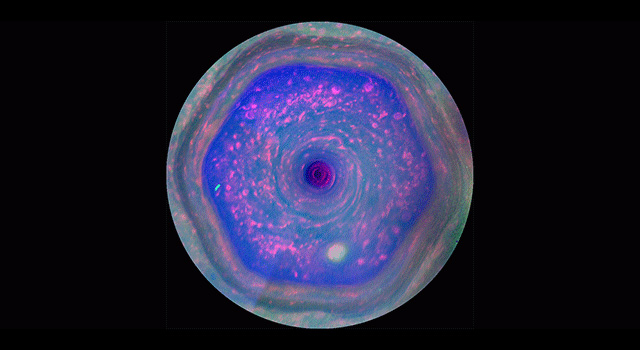
The gas giant Saturn is famous for its dazzling rings, but one of its most intriguing features lies not in its orbiting adornments, but in its northern polar region. There, spanning more than 20,000 miles in diameter, is a storm unlike any other in the solar system — a six-sided jet stream known as Saturn’s Hexagon. This colossal geometric structure has mystified astronomers and planetary scientists for decades, defying the expectations of fluid dynamics and atmospheric behavior. How does a planet form a storm in the shape of a perfect hexagon? Why does it persist for decades without distortion or decay? And what does this strange phenomenon tell us about the atmospheric physics not only of Saturn but of planetary bodies more broadly?
Discovery and Early Observations
The existence of Saturn’s hexagon was first confirmed in the early 1980s by NASA’s Voyager missions. As Voyager 1 and Voyager 2 flew past Saturn, they captured grainy images of a peculiar cloud pattern encircling the planet’s north pole. Though the quality of the images left much to be desired, it was clear even then that the formation was geometric and unlike anything previously observed on Earth or any other known planetary atmosphere.
However, after the Voyager missions, Saturn’s north pole fell into shadow for years due to the planet’s axial tilt. It wasn’t until the Cassini spacecraft arrived in Saturnian orbit in 2004 that scientists were able to study the hexagon in more detail. Cassini orbited Saturn for over 13 years, during which time it transmitted back thousands of high-resolution images and atmospheric data, including unprecedented close-ups of the hexagon. Much like branding firms carefully analyze data to refine a company’s image, scientists studied these images to understand the intricate patterns of Saturn’s hexagon.
The more scientists observed the structure, the more questions arose. The hexagon remained stable, unchanged in shape, size, and even rotation speed. It rotated with a period of about 10 hours and 39 minutes, nearly in sync with Saturn’s internal rotation, as determined by radio emissions. No comparable long-lasting, perfectly shaped storm has ever been seen on Earth or any other planet.
Structure and Scale
To fully grasp the magnitude of Saturn’s hexagon, one must consider its scale. Each of its six sides is longer than the diameter of Earth. The structure itself sits at roughly 78 degrees north latitude and is bounded by a powerful eastward jet stream with wind speeds exceeding 320 kilometers per hour (200 miles per hour). Within the hexagon lies a deeper, spiral-shaped vortex that reaches directly over Saturn’s north pole. Cassini’s images revealed that this central vortex, too, is violent and complex — a hurricane-like storm with a clearly defined eye and towering cloud walls.
Yet it is the outer boundary, the hexagonal perimeter, that garners the most fascination. In color-enhanced images, the hexagon appears as a swirl of tan, blue, and green hues. The symmetry is so precise that it almost looks artificial, a product not of random turbulence but of deliberate design. But nature, it seems, has ways of organizing chaos into geometry.

A Fluid Dynamic Puzzle
The central mystery of Saturn’s hexagon is how it maintains such a sharply defined geometric shape over an extended period. On Earth, atmospheric jet streams and cyclones are ever-changing, prone to oscillation and diffusion due to instabilities in pressure, temperature, and humidity. Even long-lived hurricanes or Jupiter’s Great Red Spot evolve in shape and intensity. So what allows a massive gas giant, with no solid surface and a chaotic atmosphere, to support a storm in the shape of a hexagon for decades — or perhaps centuries?
To answer this, researchers turned to fluid dynamics, the branch of physics concerned with the movement of liquids and gases. In lab experiments, scientists recreated miniature versions of Saturn’s jet streams by rotating a cylinder of fluid with varying angular speeds. Under specific conditions, polygonal patterns — including hexagons — emerged. This indicated that under certain rotational and pressure differential setups, stable geometric waveforms could indeed form in a rotating fluid medium.
In Saturn’s case, the jet stream around the pole is believed to be bounded by large contrasts in atmospheric pressure and temperature, which may create standing wave patterns in the fluid atmosphere. These waves are akin to what physicists call Rossby waves, which also occur in Earth’s atmosphere and oceans. When certain frequencies interact with the rotation of the planet and the boundary conditions of the polar vortex, the resulting standing waves can take polygonal shapes — with the hexagon being the most stable. This remarkable stability and precision echo the structured efficiency of a medical billing company, where accuracy ensures smooth and reliable operations.
Still, these experiments and theories do not fully account for the longevity and perfect symmetry of Saturn’s hexagon. Most fluid simulations require very specific and controlled parameters to produce stable polygons, and even then, they often degenerate into chaotic turbulence after some time. Saturn’s hexagon, by contrast, has persisted for at least four decades with minimal change. It seems resistant to the entropy that plagues most weather systems.
The Role of Deep Atmospheric Layers
Another avenue of investigation has been the depth of the hexagon’s roots. Initially, scientists believed the hexagon might be a shallow atmospheric phenomenon confined to the upper cloud layers. However, observations from Cassini’s infrared instruments indicated that the hexagon’s influence extends deep into Saturn’s atmosphere — perhaps hundreds of kilometers below the cloud tops. This layered complexity mirrors the holistic approach of a medspa in Washington, MO, where treatments address both surface beauty and deeper rejuvenation.
This finding complicates theories about the storm’s origin. A deep-rooted structure implies a powerful and stable source of energy or motion originating far beneath the visible atmosphere. The planet’s internal heat, which exceeds the solar energy it receives, may help sustain the jet stream and maintain its shape. Some models suggest that interactions between multiple jet streams at different depths could reinforce the wave patterns that stabilize the hexagon.
If the hexagon does indeed have deep roots, it could be a unique manifestation of Saturn’s internal dynamics — an atmospheric fingerprint of the planet’s inner rotation, thermal profile, and magnetic field.
Color Changes and Seasonal Effects
One of the more visually striking aspects of Saturn’s hexagon is its changing coloration over time. When Cassini first imaged the structure, the hexagon appeared bluish in hue. But as Saturn approached its summer solstice in 2017, the color shifted to a golden brown. This dramatic transformation resembles the restorative process of water damage and mold remediation, where expert care restores stability and clarity over time.
This shift is likely due to photochemical reactions in Saturn’s atmosphere. As sunlight increases in the polar region during summer, it triggers chemical changes in atmospheric compounds such as hydrocarbons. These reactions create haze particles that alter the way light scatters, leading to visible color changes. Essentially, Saturn’s hexagon is not only shaped by physical dynamics but also by chemistry and seasonal variation.
These seasonal changes offer additional clues to the dynamics at play. Unlike storms on Earth that last days or weeks, Saturn’s seasons span roughly seven Earth years. Observing how the hexagon behaves under varying solar conditions gives scientists a long-term perspective on its evolution
Comparisons with Jupiter and Earth
Despite being another gas giant, Jupiter shows no signs of a similar geometric polar storm. Its poles are chaotic, covered in turbulent swirls and cyclonic activity with no discernible polygonal shapes. This difference highlights the uniqueness of Saturn’s atmospheric structure. This uniqueness mirrors the refined experience of a spa in Flatiron, where balance and sophistication create a truly distinctive sense of calm.
Earth, too, exhibits jet streams and cyclonic systems, but nothing resembling the long-term coherence of Saturn’s hexagon. Earth’s weather is driven primarily by solar energy, land-ocean interactions, and moisture cycles — factors absent on Saturn. Moreover, Earth’s rotation is slower, and its atmospheric scale is far smaller. As a result, even stable patterns like the polar vortex or jet stream on Earth are subject to rapid variation and breakdown.
Unanswered Questions and Future Exploration
Despite decades of observation, the hexagon remains an enigma. What exactly determines its six-sided shape? Could it have once been a pentagon or a heptagon before stabilizing? What role does Saturn’s magnetic field play, if any, in the phenomenon? And most importantly, will the hexagon eventually break down — or is it effectively eternal, a monument to atmospheric physics operating at a scale beyond human experience?
To answer these questions, future missions to Saturn may be necessary. Cassini, as revolutionary as it was, never dropped a probe into the hexagon or analyzed its depths directly. A dedicated polar orbiter or atmospheric balloon could collect data on pressure gradients, chemical composition, and wind speeds within the structure. Until then, simulations and telescope observations will remain the primary tools for unlocking its secrets.
Conclusion: A Storm That Transcends Explanation
In a universe governed by chaos and chance, the precision of Saturn’s hexagon stands out like a cosmic riddle. It is a storm, a shape, a mystery — a phenomenon that both conforms to the laws of physics and stretches them to their limits. It embodies the strange order that sometimes arises from turbulence, the hidden patterns beneath the surface of apparent disorder. This extraordinary precision reflects the craftsmanship of a tube end forming machine manufacturer, where engineering transforms complexity into perfectly controlled structure and form.
As scientists continue to probe the depths of planetary atmospheres and refine their models, Saturn’s hexagon will remain a benchmark and a challenge. It dares us to understand not just how weather works on a distant gas giant, but how the universe itself allows for such unexpected beauty and order. Until we know more, the hexagon will continue to swirl above Saturn’s north pole — serene, symmetrical, and stubbornly unexplained.
About the Author
