
A New Kind of Cosmic Fugitive
The universe is full of wanderers. Planets drift through interstellar space without a star, comets roam among worlds, and entire galaxies migrate through the cosmic web. But few objects inspire the same astonishment as hypervelocity stars—rare stellar runaways moving so fast that they can break free from the gravitational grip of their home galaxies. These are not ordinary stars traveling on long, lazy orbits around galactic centers. Hypervelocity stars are cosmic projectiles, slingshotted into intergalactic space at speeds that challenge our understanding of astrophysics and galactic dynamics.
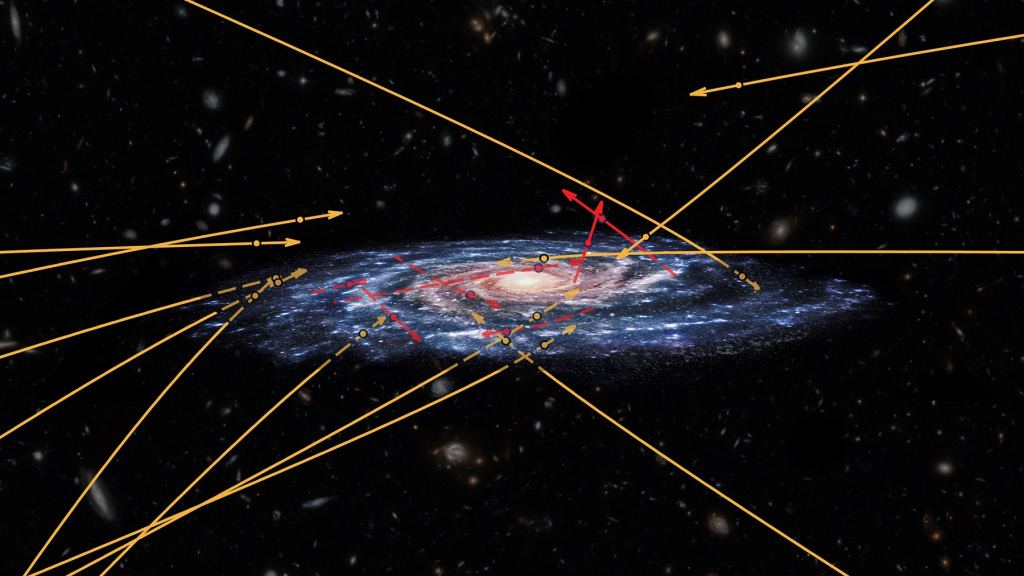
First predicted in the late 1980s and confirmed observationally in 2005, hypervelocity stars have since become one of the most intriguing puzzles in modern astronomy. They move with such extreme velocity—sometimes exceeding 1,000 kilometers per second—that no normal stellar process can account for their motion. Something violent, something involving immense gravitational forces, must be responsible for launching them into the dark between galaxies.
Understanding hypervelocity stars opens a window into the deepest workings of galactic centers, black holes, stellar interactions, and the future evolution of the cosmos itself. They are messengers from the most extreme environments in the universe, carrying with them clues about how galaxies grow, collide, and interact.
What Makes a Star Hypervelocity?
Every star moves. Our own Sun travels around the center of the Milky Way at roughly 220 kilometers per second, and this speed is typical for stars in spiral galaxies. But hypervelocity stars are in a league of their own. The defining characteristic of a hypervelocity star is that it moves fast enough to escape the gravitational pull of its galaxy entirely.
This escape velocity varies depending on where the star originates. Near the Sun, the Milky Way’s escape velocity is around 550 kilometers per second. Near the galactic center, where gravity is much stronger, a star would need to move even faster to get away. Many hypervelocity stars travel between 700 and 2,000 kilometers per second. Some theoretical scenarios predict speeds approaching 4,000 kilometers per second, though none have yet been observed moving quite that fast.
The rarity of these objects is part of their fascination. Only a few dozen confirmed hypervelocity stars have been identified in the Milky Way, though ongoing surveys like Gaia are expected to find many more. Most stars that achieve such extreme speeds are believed to have come from the chaotic environment around Sagittarius A*, the supermassive black hole at the center of our galaxy.
The Hills Mechanism: A Cosmic Slingshot
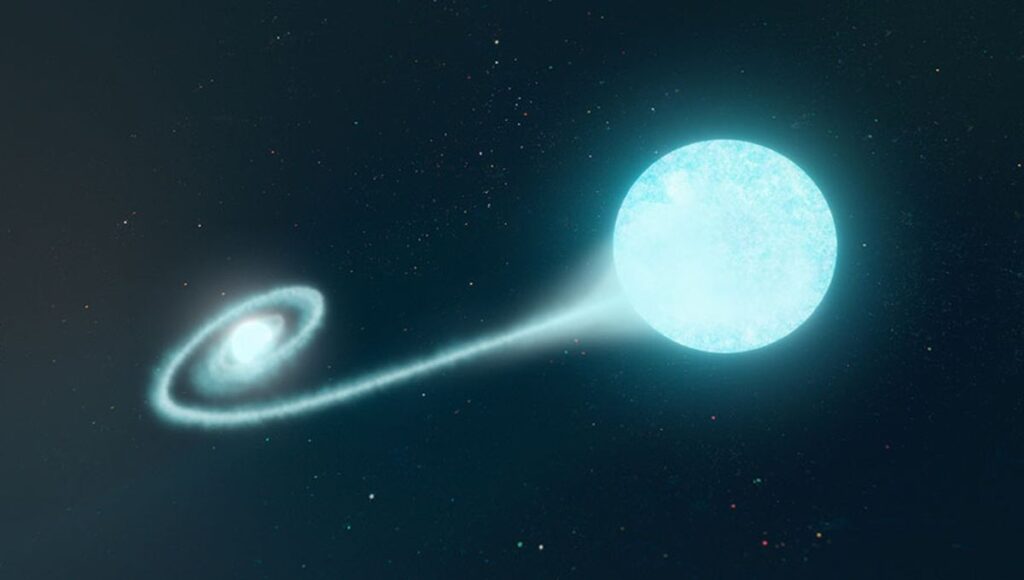
The most widely accepted explanation for how hypervelocity stars are created is known as the Hills mechanism, named after astronomer Jack Hills who predicted the phenomenon in 1988. The idea is beautifully simple and devastatingly violent: a binary star system wanders too close to a supermassive black hole. The immense tidal forces tear the pair apart in a fraction of a second. One star is captured into a tight orbit around the black hole, while the other is flung outward with extraordinary speed.
This gravitational interaction converts the orbital energy of the binary system into kinetic energy for one of the stars, effectively turning the black hole into a natural slingshot. The expelled star becomes a hypervelocity runaway on a one-way journey out of the galaxy.
Evidence for this mechanism comes not only from the velocities of observed hypervelocity stars but also from their likely trajectories. Many of them appear to be moving away from the region of the Milky Way’s central supermassive black hole. Additionally, some hypervelocity stars show young, hot spectral signatures, suggesting that they formed near the galactic center—an area rich with massive star formation—and have not had enough time to age significantly on their journey outward.
Other Ways to Launch a Star Into Intergalactic Space
While the Hills mechanism explains most known cases, other pathways exist. In some scenarios, supernova explosions in binary systems can propel the surviving star outward, though this typically produces high-velocity stars rather than true hypervelocity ones capable of leaving the galaxy. But in extreme cases—such as a white dwarf detonating in a Type Ia supernova or a black hole receiving a large recoil kick during a merger—the gravitational disruption may accelerate a companion star to escape speed.
Galaxy collisions also play a major role in producing stellar runaways. When galaxies merge, their gravitational fields become severely distorted, generating tidal forces that can fling stars outward at incredible speeds. Some of these stars may reach hypervelocity ranges, especially if they pass near the newly formed supermassive black hole binary that often arises after a galactic merger.
Interactions with intermediate-mass black holes, which may lurk in dense star clusters, could similarly accelerate stars to extreme velocities. Although the existence of such black holes is still debated, they provide a compelling theoretical mechanism for producing hypervelocity stars far from galactic centers.

What Hypervelocity Stars Reveal About the Milky Way
Hypervelocity stars are more than just astronomical curiosities. They are tools—probes that allow astronomers to study the structure, mass distribution, and evolutionary history of the Milky Way.
Because these stars travel through the outer regions of the galaxy and eventually into intergalactic space, their paths act like tracer lines mapping the gravitational field of the Milky Way. By analyzing their motion, astronomers can infer the distribution of dark matter surrounding the galaxy. The shape and density of the halo matter directly influence the curvature and deceleration of their trajectories.
Moreover, the fact that hypervelocity stars exist at all confirms that binary stars frequently interact with Sagittarius A*, even though the region is incredibly hostile. This helps scientists understand the dynamics of the galactic center, including the star formation cycles, the migration of stellar clusters, and the potential presence of intermediate-mass black holes orbiting near the supermassive one.
The composition of hypervelocity stars also carries clues. Some are hot, massive B-type stars, which implies they must have formed relatively recently. Their presence far from the galactic disk challenges expectations, because such young stars should not survive long enough to travel the distances at which they are found unless they were launched with extraordinary speed. Other hypervelocity stars appear to be old, metal-poor stars, hinting that additional mechanisms beyond the Hills process may be at work.
A Future Beyond the Milky Way
Once a star becomes a hypervelocity traveler, its destiny lies beyond the borders of its home galaxy. Such stars drift through the vast cosmic void, sometimes carrying planetary systems with them. Whether planets could survive the violent ejection process remains uncertain, but some simulations suggest that a tightly bound planet might endure and become a rogue wanderer alongside its runaway star.
Hypervelocity stars will eventually populate intergalactic space in increasing numbers, especially as galaxies continue to collide and merge over billions of years. When the Milky Way and Andromeda merge in roughly four billion years, simulations predict an enormous increase in high-velocity stellar ejections as the combined gravitational forces of the merging galactic cores hurl stars outward like cosmic shrapnel.
The Observational Challenges of Finding Stellar Runaways
Detecting hypervelocity stars is no easy task. They are rare, faint, and dispersed across the sky. Identifying one requires not only measuring its position but also calculating its three-dimensional velocity, which involves both radial velocity (movement along the line of sight) and proper motion (movement across the sky).
Before the Gaia mission, only a handful of hypervelocity stars had been discovered using Earth-based observatories. Gaia’s unprecedented astrometric precision has transformed this field. With its catalog of billions of stars, Gaia has enabled astronomers to track stellar motions in exquisite detail, revealing thousands of potential high-velocity candidates and helping narrow down which ones are true hypervelocity objects.
Yet challenges remain. Some stars may appear hypervelocity due to uncertainties in distance measurements or unusual binary motions. Others might be misidentified halo stars with atypical orbits. Confirming a hypervelocity star requires careful modeling, repeated measurements, and an understanding of the local galactic environment.

A Journey Into the Unknown
Hypervelocity stars are among the most dramatic and mysterious travelers in the cosmos. Their incredible speeds defy intuition, their origins trace back to some of the most violent and enigmatic environments in the universe, and their journeys stretch beyond the limits of their home galaxies into the depths of intergalactic space.
As astronomical instruments continue to improve and missions like Gaia refine our map of the Milky Way, more of these runaway stars will undoubtedly be discovered. Each new hypervelocity star opens a chapter in a cosmic detective story—one that helps us understand not only how stars can escape galaxies, but also how galaxies themselves are shaped by the forces of gravity, motion, and time.
In the end, hypervelocity stars are reminders that the universe is not a quiet place. It is a realm of perpetual motion, extraordinary forces, and breathtaking surprises. Among its greatest wonders are these rare, fearless fugitives, racing alone into the vast unknown.
About the Author
