

A New Cosmic Perspective
For most of human history, the night sky was a canvas of mystery, myth, and meaning. Ancient civilizations mapped the stars into gods, heroes, and omens, using the heavens to explain the unknown and anchor their place in the world. While early astronomy offered calendars and navigation, it also reinforced the idea that Earth—and by extension humanity—occupied a central position in the cosmos. Modern astronomy has steadily dismantled that view. In doing so, it has not diminished humanity’s significance but instead reshaped how we understand our role in an unimaginably vast universe.
Over the past century, and especially in recent decades, technological advances have transformed astronomy from naked-eye observation into a precision science capable of probing the deepest reaches of space and time. Telescopes orbit above Earth’s atmosphere, detectors capture invisible wavelengths, and computers process data from billions of celestial objects. These developments are not merely expanding our scientific knowledge; they are fundamentally redefining humanity’s place in the universe, challenging long-held assumptions about uniqueness, centrality, and purpose.
From a Geocentric World to a Cosmic Web
One of the most profound shifts in human thought came with the realization that Earth is not the center of the universe. The Copernican revolution displaced our planet from the cosmic center, and later discoveries revealed that even the Sun is just one star among hundreds of billions in the Milky Way. Modern astronomy has taken this humbling process much further.
Today, astronomers understand that the Milky Way itself is only one galaxy in a vast cosmic web containing hundreds of billions of galaxies. These galaxies are arranged along filaments of dark matter, separated by immense voids, forming a structure so large that it challenges human intuition. Our cosmic address is no longer simple or privileged: we reside on a small planet orbiting an average star in an unremarkable region of a spiral galaxy, itself part of a local group on the outskirts of a supercluster.
This perspective has profound philosophical implications. Humanity is not the focal point of creation in a spatial sense, yet our ability to comprehend this structure gives us a unique role as observers. Modern astronomy reframes significance not in terms of location, but in terms of awareness.
Seeing the Universe in Deep Time
Modern astronomy does more than map space; it reveals time on a scale that dwarfs human history. Because light travels at a finite speed, observing distant objects means looking back in time. When astronomers study galaxies billions of light-years away, they are witnessing the universe as it existed billions of years ago.
This concept of deep cosmic time has transformed our understanding of existence. The universe is approximately 13.8 billion years old, and Earth formed relatively late in its history. Humanity’s entire recorded past occupies only the final fraction of a second on the cosmic clock. While this realization can feel unsettling, it also places human civilization within a grand narrative of cosmic evolution that began with the Big Bang.
Modern observations of the cosmic microwave background, stellar life cycles, and galactic evolution show that the elements essential for life were forged in the hearts of stars. Carbon, oxygen, and iron—the building blocks of planets and people—were created through nuclear fusion and scattered across space by supernova explosions. In this sense, modern astronomy reveals that humanity is not separate from the universe but deeply connected to it. We are, quite literally, made of star stuff.
The Search for Other Worlds
Perhaps no discovery has more directly challenged humanity’s sense of uniqueness than the detection of exoplanets. Until the late twentieth century, planets beyond our solar system were purely speculative. Today, thousands of exoplanets have been confirmed, with many more candidates awaiting verification.
These discoveries have revealed an astonishing diversity of worlds. Astronomers have identified massive gas giants orbiting close to their stars, rocky planets larger than Earth, and planets locked in extreme environments unlike anything found in our solar system. Most significantly, some exoplanets reside within their stars’ habitable zones, where liquid water could exist on the surface.
The realization that planets are common throughout the galaxy suggests that the conditions for life may also be widespread. Modern astronomy has shifted the question from whether other worlds exist to how many might resemble Earth in meaningful ways. This transition has deep implications for humanity’s self-image. If life arises elsewhere, even in simple forms, it would mean that biology is a cosmic phenomenon rather than a singular accident.
Astrobiology and the Question of Life
Modern astronomy increasingly overlaps with biology through the emerging field of astrobiology. Scientists now study how life might arise under different conditions, how it could be detected from afar, and how resilient it might be in extreme environments. Observations of moons like Europa and Enceladus, which harbor subsurface oceans beneath icy crusts, have expanded the notion of where life could exist.
Telescopes are also being designed to analyze the atmospheres of distant exoplanets for chemical signatures associated with life, such as oxygen, methane, or complex organic molecules. While no definitive evidence of extraterrestrial life has yet been found, the tools to search for it are more sophisticated than ever before.
The impact of this search extends beyond science. The possibility that life exists elsewhere forces humanity to confront questions once confined to philosophy and religion. What would it mean to share the universe with other living beings? How would such a discovery reshape concepts of identity, morality, and purpose? Modern astronomy does not provide answers to these questions, but it ensures they can no longer be ignored.
Dark Matter, Dark Energy, and the Limits of Knowledge
While modern astronomy has illuminated much about the universe, it has also revealed how much remains unknown. Observations show that ordinary matter—the atoms that make up stars, planets, and people—accounts for only a small fraction of the universe’s total content. The rest consists of dark matter and dark energy, mysterious components that do not emit or absorb light but dominate cosmic behavior.
Dark matter appears to provide the gravitational scaffolding that allows galaxies to form and remain intact, while dark energy drives the accelerated expansion of the universe. Despite their importance, both remain poorly understood. Their existence is inferred through their effects rather than directly observed.
This confrontation with the limits of knowledge is itself transformative. Modern astronomy teaches humility, reminding humanity that even with advanced technology and mathematical models, the universe retains profound mysteries. At the same time, it highlights the power of human curiosity and ingenuity in uncovering truths that once seemed forever beyond reach.
Technology and the Expanding Human Gaze
The redefinition of humanity’s place in the universe would not be possible without technological innovation. Space-based observatories, adaptive optics, and radio telescope arrays have expanded the range of observable phenomena across the electromagnetic spectrum. Astronomers can now study everything from the formation of planets to the collision of black holes through gravitational waves.
These technologies effectively extend human senses beyond natural limits. We can “see” infrared light to peer through cosmic dust, detect X-rays from extreme environments, and measure subtle ripples in spacetime itself. In doing so, modern astronomy blurs the line between observer and cosmos. Humanity becomes an active participant in the universe’s self-exploration.
The collaborative nature of modern astronomy also reflects a shift in perspective. Large-scale projects often involve international teams sharing data and expertise across borders. In studying the universe, humanity increasingly acts as a single species rather than as divided nations, united by a common quest to understand the cosmos.
Cultural and Philosophical Implications
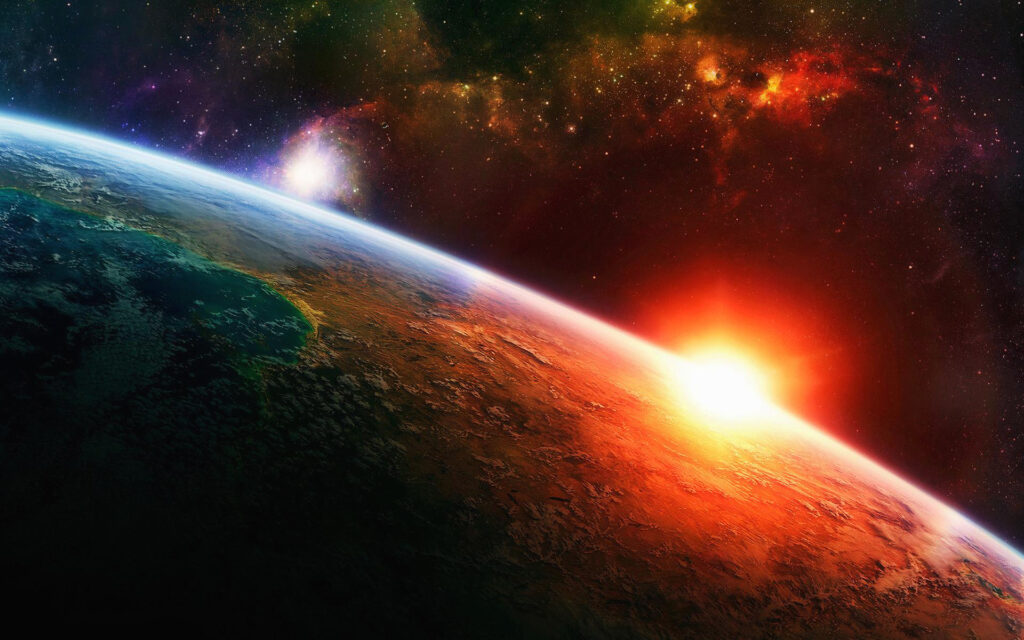
As modern astronomy reshapes scientific understanding, it also influences culture, art, and philosophy. Images of distant nebulae and galaxies inspire awe and challenge anthropocentric worldviews. The realization that Earth is fragile and isolated within a vast cosmic environment has contributed to a growing awareness of planetary stewardship.
From this perspective, Earth appears not as a limitless resource but as a rare and precious oasis. Seeing our planet from a cosmic vantage point encourages reflection on shared responsibility and interconnectedness. Modern astronomy thus indirectly informs ethical considerations about environmental preservation, cooperation, and the long-term survival of civilization.
Humanity’s Place Reimagined
Modern astronomy does not offer comfort in the traditional sense. It replaces familiar certainties with immense scales and unsettling possibilities. Yet it also offers a deeper form of meaning rooted in connection and curiosity. Humanity’s place in the universe is no longer defined by centrality or dominance, but by participation in an ongoing story of cosmic evolution.
We are products of ancient stars, inhabitants of a planet shaped by billions of years of change, and observers living at a time when the universe has become aware of itself through scientific inquiry. In redefining our place, modern astronomy does not diminish humanity. Instead, it invites us to embrace a broader identity—one that recognizes our smallness without surrendering our significance.
About the Author
