

The Far Future of Everything
Human imagination often struggles to grasp vast timescales. We measure our lives in decades, our civilizations in millennia, and our species in a few hundred thousand years. Yet the universe itself is ancient beyond human reckoning—already over 13.8 billion years old. In that expanse, stars were born, galaxies took shape, and life emerged on a small blue planet orbiting a rather ordinary star. But what lies ahead—what will the universe look like not in millions or billions, but in a trillion years?
To peer that far forward is to gaze into an age so remote that the structures we know—stars, galaxies, even atoms themselves—will be transformed or gone. The story of the cosmos is one of creation, evolution, and entropy, and in a trillion years, the universe will have entered one of its final, quiet chapters.
The Present Cosmic Era: A Universe Alive with Light
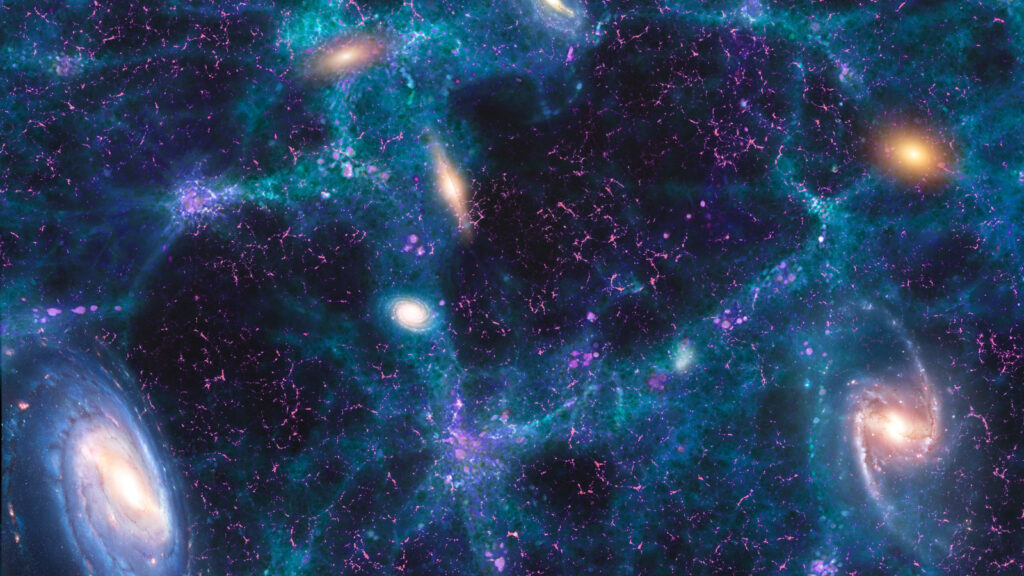
We live in what cosmologists call the Stelliferous Era—the age of stars. From roughly 100 million years after the Big Bang until about 100 trillion years in the future, the universe will be filled with the light of stellar fusion. During this era, hydrogen and helium coalesce into stars, stars forge heavier elements, and galaxies sparkle with their combined brilliance.
Right now, the Milky Way alone hosts around 100–400 billion stars, most of them still burning or newly formed. Across the observable universe, there are roughly two trillion galaxies, each a vast city of suns. This is a universe in its prime—a cosmos alive, dynamic, and still evolving.
A Trillion Years From Now: The End of Star Formation
In one trillion years—10¹² years into the future—the cosmic landscape will be profoundly different. Star formation, which depends on the presence of cold gas clouds, will have all but ceased. Most of the hydrogen and helium available for creating new stars will be locked inside stellar remnants: white dwarfs, neutron stars, and black holes.
Galaxies, including the Milky Way, will have exhausted their star-forming material. Even before the trillion-year mark, the Milky Way and Andromeda will have merged into a single elliptical supergalaxy sometimes nicknamed “Milkdromeda.” That event will occur about 4–5 billion years from now, but by a trillion years, its structure will have settled into a dim, spherical system of long-dead stars and remnants slowly orbiting a massive central black hole.
The cosmic web that currently binds galaxies together will have thinned, stretched by the accelerating expansion of space. Most galaxies will drift beyond each other’s cosmic horizon, meaning their light can no longer reach one another. To any observer in that distant age, the universe will seem lonely and dark, with only the gravitationally bound remnants of local galaxies remaining visible.
The Fading of the Stars
Even within that remaining island of light, change is inevitable. The most massive stars burn out quickly, often in just a few million years, while smaller stars like our Sun endure for billions. But the true champions of longevity are red dwarfs, small, cool stars that can shine for trillions of years.
By the one-trillion-year mark, most of the red dwarfs that exist today will still be burning faintly, though their light will be weak and reddish. However, star formation will have stopped so long ago that no new stars will replace those that die. One by one, they too will exhaust their hydrogen, dimming into white dwarfs—stellar cores that glow faintly from residual heat.
The Death of Light
By the time a trillion years has passed, light itself will have become rare. The cosmic background radiation, the afterglow of the Big Bang, will have stretched to such long wavelengths that it will be undetectable. The visible universe will be utterly dark to human eyes—if any humans or their descendants somehow persist.
In that future, even if intelligent beings arise or endure, they would find the evidence of the universe’s origin erased. The stars that once mapped the galaxies will be gone, the cosmic microwave background will have faded beyond detection, and the expansion of space will have carried most of the universe out of view. They might look into the sky and see nothing—no hint of other galaxies, no clue that the cosmos was ever filled with light.
The Reign of the Black Holes
As stellar remnants cool and fade, black holes will come to dominate the cosmos. These titanic objects will rule the gravitational landscape, silently devouring anything that wanders too close. The supermassive black hole at the center of the Milky Way, Sagittarius A*, will remain, as will others in merged galaxies. Over eons, smaller black holes may coalesce into even larger ones.
Yet even black holes are not eternal. According to Stephen Hawking’s theory of black hole radiation, they will slowly evaporate over unimaginable spans of time. A black hole with the mass of our Sun will take roughly 10⁶⁷ years to evaporate—a number so vast it dwarfs a trillion many times over. The supermassive ones at galactic centers will last far longer—perhaps 10¹⁰⁰ years before they finally vanish in a faint flash of radiation.
The Dark Era: When Even Decay Fails
Eventually, after the last black holes evaporate, the universe will enter what physicists call the Dark Era. This epoch lies so far ahead that even numbers fail to convey its immensity—10¹⁰⁰ years or more into the future.
In this time, the universe will be composed mostly of subatomic particles and radiation—a thin, cold fog of electrons, positrons, neutrinos, and photons drifting endlessly through expanding space. The average temperature of the cosmos will approach absolute zero, and matter will exist only in scattered remnants.
The Role of Dark Energy
The expansion of the universe, first observed by Edwin Hubble and later found to be accelerating due to dark energy, will profoundly shape this distant future. Dark energy causes the universe to expand faster and faster, driving galaxies apart and pushing them beyond causal contact.
In the next few trillion years, this acceleration will ensure that distant galaxies become unobservable, effectively isolating each remaining cluster of matter. Even gravity itself cannot overcome this expansion at the largest scales. Eventually, observers in any one region of the cosmos will see only the stars and remnants bound by their local gravity—everything else will vanish beyond reach.
If dark energy remains constant, the expansion will continue forever. If it grows stronger, it could one day tear apart even galaxies, atoms, and space itself in a hypothetical event known as the Big Rip. But if it weakens or changes form, other fates—such as a slow collapse—might follow. For now, the data suggest a cosmos destined for eternal expansion, cold and dark.
The Quiet Beauty of the End
Though bleak in one sense, the far future of the universe is also profoundly poetic. From a scientific perspective, it represents the ultimate consequence of the second law of thermodynamics: energy spreads, order decays, and systems evolve toward equilibrium. But in another sense, it is the completion of the universe’s story—the natural conclusion to a cosmic arc that began with brilliance and ends in silence.
Even in that silence, beauty remains. The black dwarfs that fill the galaxy will be frozen jewels drifting in space. The last flicker of Hawking radiation from a dying black hole will mark the final whisper of creation’s fire. The expansion of space itself will continue—a vast, cold sea with no shore, but still existing, still real.
Humanity’s Place in the Distant Future
It is humbling to realize that every human achievement, every civilization, and every star in the night sky exists within a fleeting moment of cosmic time. A trillion years is a span we cannot experience, yet it is part of the same continuum that began with the Big Bang.
Even if humanity or its descendants somehow survive across eons—through biological evolution, artificial intelligence, or other means—they will face a universe that grows darker and lonelier with every passing epoch. The ability to harness or rekindle energy in such a cold cosmos would become the ultimate challenge.
The Eternal Night
In a trillion years, the universe will no longer resemble the one we know. The galaxies will be dim shadows, the stars gone cold, and the night sky truly black. The cosmos will have passed from youth to age, from fire to frost.
Yet even in that distant epoch, the universe will still exist. Space and time will endure, perhaps forever. The energy of creation will not vanish; it will only become diffuse, stretched across the infinite void.
In that sense, the universe’s death is not destruction but transformation—a slow metamorphosis from light to darkness, from motion to stillness. The stars will fade, but the memory of their brilliance will be written in the atoms forged within them, in the laws that continue to govern all that remains.
About the Author
