

The Invisible Realm Between the Stars
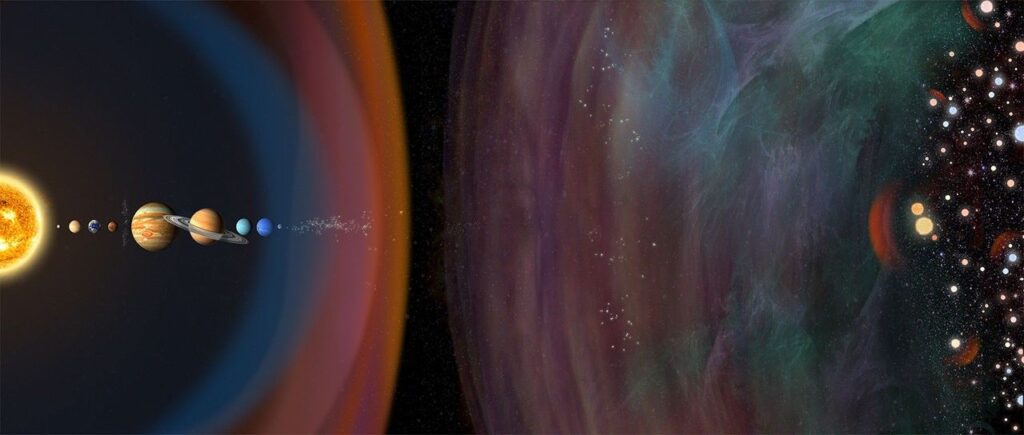
When we gaze into the night sky, it’s tempting to think of the universe as mostly empty space dotted with brilliant points of light—stars, planets, and galaxies. Yet this impression is deceiving. The regions between stars, often dismissed as voids, are far from empty. They form what astronomers call the interstellar medium, a vast and dynamic ocean of gas, dust, magnetic fields, and cosmic rays that fills the space between stars and threads throughout galaxies like the connective tissue of the cosmos. Though tenuous and diffuse—far thinner than the best vacuum ever created on Earth—this medium plays an indispensable role in shaping the life cycle of stars, influencing galactic evolution, and even determining the conditions for the formation of planets and, ultimately, life itself.
The interstellar medium, often abbreviated as ISM, is not a mere backdrop to cosmic events. It is the stage upon which stars are born and die, where shockwaves ripple from supernovae, and where matter is recycled and reassembled into new celestial bodies. Understanding this invisible material has become one of the great frontiers of modern astrophysics, revealing that what lies between the stars is as crucial to the universe’s story as the stars themselves.
The Composition of the Cosmic Ocean
At its simplest, the interstellar medium is composed primarily of hydrogen, the most abundant element in the universe, making up about 90 percent of its atoms. Helium accounts for roughly 9 percent, while the remaining one percent consists of heavier elements—carbon, oxygen, silicon, iron, and others—known collectively as “metals” in astronomical terminology. These trace elements, though numerically scarce, are of outsized importance. They are the raw materials from which planets, organic molecules, and life emerge.
The ISM exists in several forms, or phases, depending on temperature, density, and ionization state. Cold, dense molecular clouds harbor molecules like H₂ and serve as stellar nurseries, while warm atomic gas and hot ionized plasma populate the spaces between. The temperatures of these regions can range from just a few tens of degrees above absolute zero to millions of degrees in the aftermath of supernova explosions.
The Cycle of Matter: Birth, Death, and Rebirth
Every atom that makes up our planet—and indeed, our bodies—has participated in this interstellar cycle of creation and destruction. The interstellar medium acts as the crucible of cosmic recycling, where matter expelled by dying stars eventually becomes the building material for new ones.
When a star like our Sun exhausts its nuclear fuel, it sheds its outer layers, enriching the surrounding space with elements like carbon, nitrogen, and oxygen. In more massive stars, the end comes in a cataclysmic supernova, which blasts heavy elements forged in the stellar core across the galaxy. These metals mix with the existing interstellar gas, forming enriched clouds that can later collapse under gravity to form the next generation of stars and planets.
The Role of Dust: Tiny Grains, Big Impact
While the gas component of the ISM often takes center stage, interstellar dust plays an equally significant role. These tiny particles, composed of silicates, carbon, and ices, account for only about 1 percent of the interstellar medium’s mass, yet they profoundly affect its chemistry and energy balance.
Dust grains absorb and scatter starlight, dimming and reddening the appearance of distant stars—a phenomenon known as interstellar extinction. This effect once frustrated astronomers trying to map the Milky Way, as vast dust clouds obscured large portions of the galactic disk. But dust also serves as a vital catalyst for chemical reactions. On the surfaces of these microscopic grains, simple atoms can combine to form molecules such as molecular hydrogen (H₂), carbon monoxide (CO), and even more complex organic compounds.
Star Formation: Where Darkness Gives Birth to Light
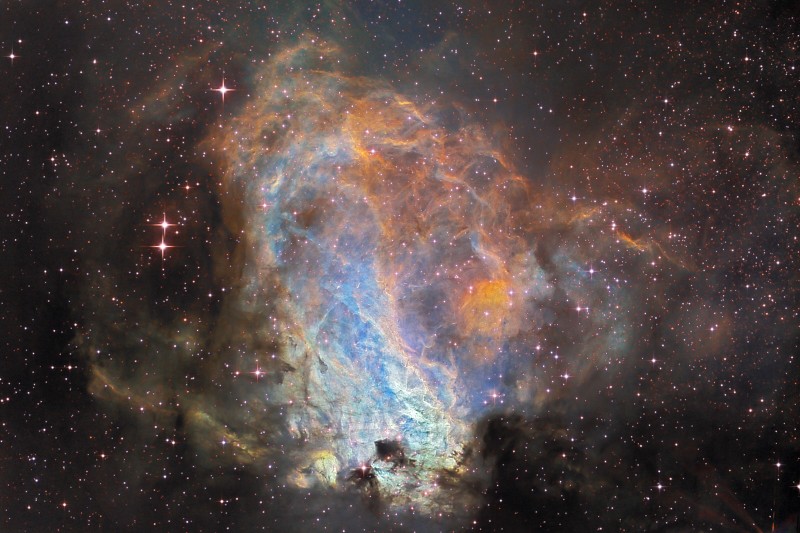
Within the interstellar medium, certain regions become dense and cold enough for gravity to take over, pulling material inward until a protostar forms at the core. These regions, known as molecular clouds, are the true birthplaces of stars.
The process begins with subtle instabilities—perhaps triggered by a passing shockwave from a nearby supernova or the spiral density waves of a galaxy’s rotating arms. Once a portion of the cloud collapses, it fragments into smaller cores, each of which can form a star or a multiple-star system. As the protostar grows, it heats up and eventually ignites nuclear fusion, marking its transformation into a main-sequence star.
Turbulence and Magnetism: The Invisible Forces
If we could drift through the interstellar medium, we would encounter not serene emptiness but a roiling sea of turbulent motion. The gas and dust are stirred by gravitational forces, supernova explosions, and galactic rotation, creating complex flows that stretch across light-years.
Embedded within this chaos are magnetic fields, subtle yet powerful. They thread through the interstellar gas like invisible strings, guiding the motion of charged particles and shaping the structure of molecular clouds. These fields can slow the collapse of clouds, influence the direction of star-forming filaments, and even channel cosmic rays—high-energy particles that travel at nearly the speed of light.
Cosmic Rays: The Energetic Messengers
Among the most mysterious components of the interstellar medium are cosmic rays—charged particles, mainly protons and atomic nuclei, that move through space at relativistic speeds. These particles, born in the violent aftermaths of supernovae and other energetic events, permeate the galaxy and play a subtle but profound role in interstellar chemistry.
As cosmic rays collide with atoms and molecules in the ISM, they ionize and excite them, triggering chemical reactions that would otherwise be impossible in the cold and dark of space. They also contribute to heating the gas and influencing its ionization balance. For planets with atmospheres, cosmic rays can affect climate and even biological evolution by modulating the levels of radiation reaching the surface.
How We Study the Invisible
The interstellar medium cannot be observed directly with optical telescopes alone. Most of its components either absorb visible light or emit radiation in wavelengths invisible to the human eye. To study it, astronomers rely on a spectrum of observational tools—from radio telescopes that detect hydrogen’s characteristic 21-centimeter emission line to infrared observatories that reveal the glow of dust and X-ray satellites that trace hot, ionized gas.
Missions such as the Hubble Space Telescope, the Spitzer Space Telescope, and more recently, the James Webb Space Telescope (JWST) have provided unprecedented views of interstellar structures, from dark nebulae to star-forming regions like the Pillars of Creation. Meanwhile, radio arrays such as ALMA (Atacama Large Millimeter/submillimeter Array) allow scientists to map the distribution of molecules with exquisite precision.
The ISM’s Role in Galactic Evolution
Galaxies are not static islands of stars—they are living systems whose fates are intimately tied to their interstellar media. The ISM acts as a fuel reservoir for star formation, determining how actively a galaxy can create new stars. When this gas supply is depleted or heated beyond the point of collapse, star formation dwindles, and the galaxy gradually fades.
Feedback from stars—particularly from massive stars and supernovae—injects energy back into the ISM, driving winds and outflows that can expel gas into intergalactic space. This feedback cycle regulates galactic growth and may explain why galaxies come in such diverse forms, from starburst galaxies brimming with new stars to quiescent ellipticals that have long since gone silent.
The Future of ISM Research
The coming decades promise a golden age for studying the interstellar medium. With instruments like JWST, ALMA, and the upcoming Square Kilometre Array (SKA), scientists will map its structure and dynamics in unprecedented detail. Future missions may even directly sample interstellar dust and gas as spacecraft like Voyager and New Horizons venture deeper into the local interstellar environment.
On the theoretical side, advances in computational astrophysics will continue to refine our models of turbulence, magnetism, and chemistry within the ISM. These efforts will not only deepen our understanding of how galaxies evolve but may also reveal the universal processes that govern the formation of stars and worlds across the cosmos.
Conclusion: The Ocean That Connects Us All
The interstellar medium is far more than the emptiness between stars—it is the cosmic ocean that sustains the universe’s eternal rhythm of creation and destruction. In its diffuse gas and dust lie the ingredients of stars, planets, and life itself. It is the silent witness to billions of years of cosmic history and the arena in which the universe continually renews itself.
By exploring this invisible realm, we are not just studying the mechanics of the cosmos; we are uncovering the story of our own origins. Every atom in our bodies was once adrift in the interstellar medium, waiting to be woven into the fabric of a new world. In that sense, the vast ocean between the stars matters more than we could ever imagine—for it is, quite literally, the place from which we all come.
About the Author
